 Feb, 2026
  450 views
  3 min Read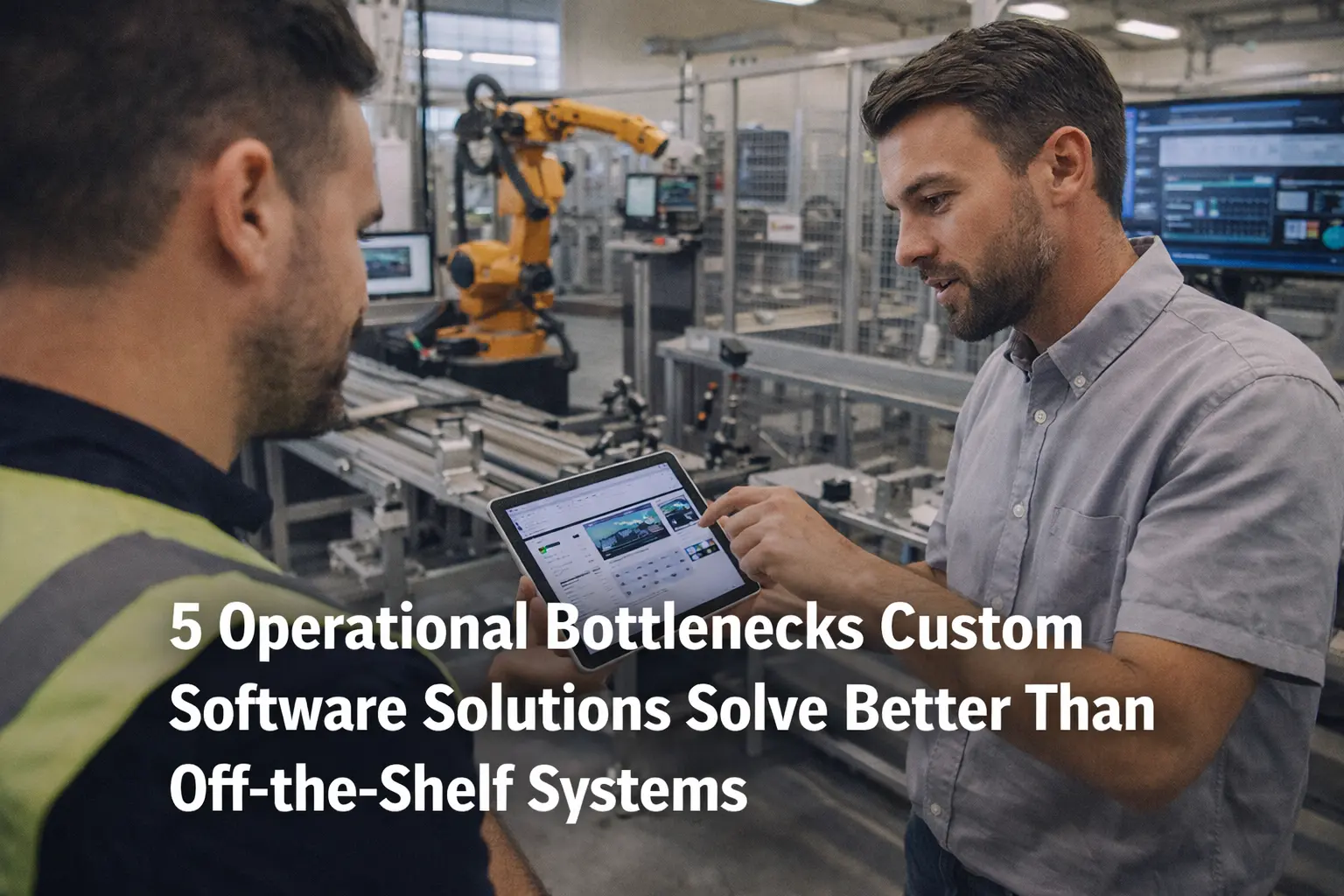
- The Five Constraint Domains Where Generic Software Fails—And Custom Solutions Win
- The Pattern: Why Custom Software Solutions Outperform
- The Compounding Impact (Why It Pays Back)
- Five Questions: Is Custom Manufacturing Software Worth It Here?
- Conclusion: Build the Advantage or Compete Without It
Two plants can run the same equipment in the same industry on the same ERP and deliver radically different outcomes. One operates at 85 percent OEE with 3 percent scrap and 99 percent inventory accuracy. The other sits at 65 percent OEE, 7 percent scrap, and 75 percent accuracy. The difference is not the enterprise systems they purchased. Those are increasingly table stakes. It is the intelligent operational layers they built on top to close the gap between standardized workflows and plant reality.
The data is clear. Average OEE remains 60 to 70 percent while leading operations exceed 85 percent. Cost of Poor Quality often runs 15 to 25 percent of manufacturing costs while leaders push below 10 percent. Inventory accuracy typically ranges from 70 to 85 percent while best in class reaches 99 percent or more. Unplanned downtime commonly sits at 10 to 15 percent while predictive environments drive it below 5 percent.
That delta represents tens of millions in annual capacity, margin, and working capital. For manufacturing leaders, the competitive battle is no longer won through ERP alone. It is won in the last mile with constraint specific operational intelligence that turns complexity into measurable advantage.
These aren't edge cases. They're the five recurring bottlenecks where off-the-shelf systems break down and intelligent manufacturing operations pull ahead through custom software solutions.
1. Production Scheduling Optimization
The Gap:
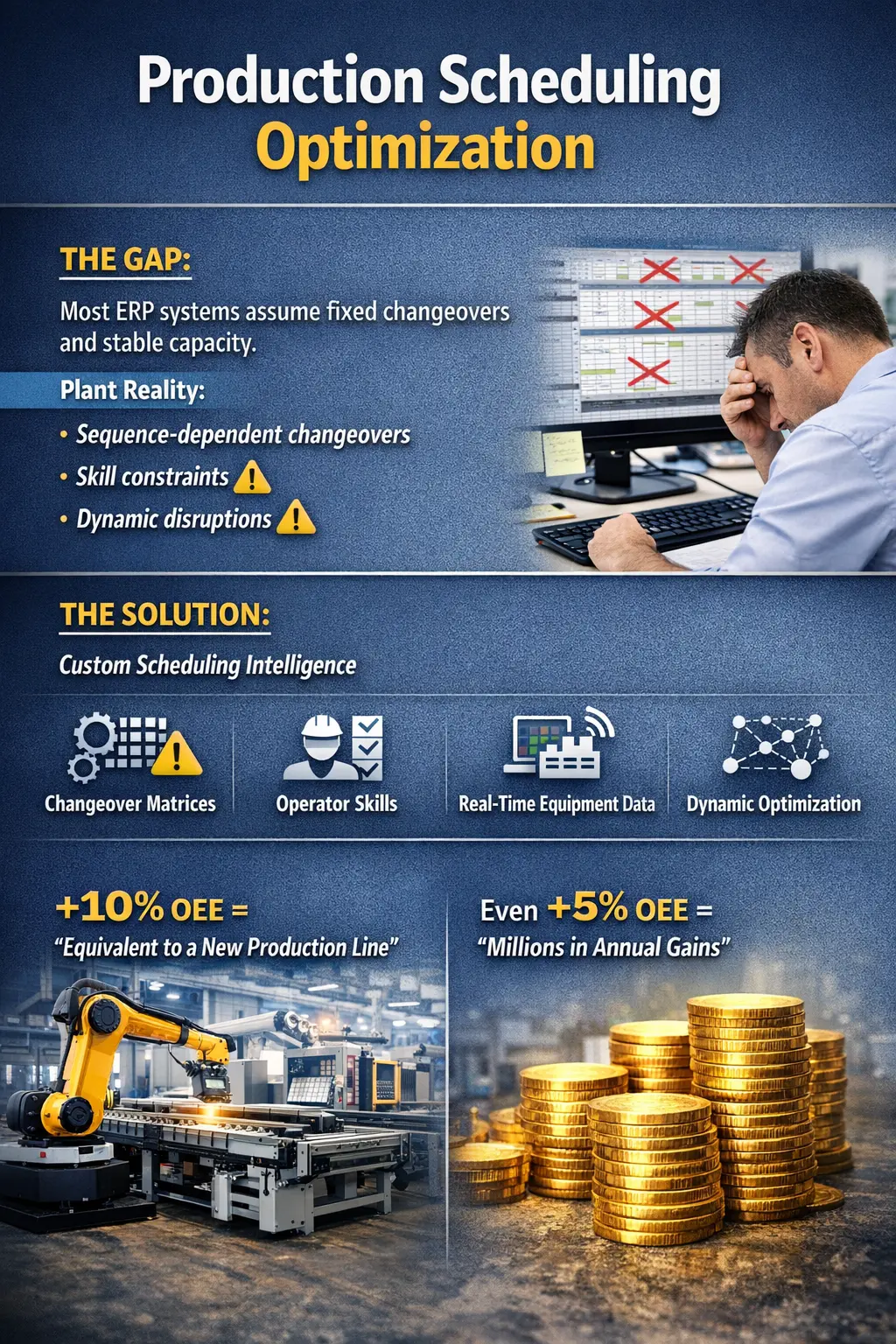
The gap is clear. Most ERP and planning tools are built on linear assumptions such as fixed changeover times and stable capacity. Plant reality is more dynamic. Changeovers are sequence dependent, labor is skill constrained, and daily disruptions from maintenance, material variability, and expedites constantly reshape feasible plans. When these assumptions break, planners revert to spreadsheets. Schedule adherence drops, variability increases, and throughput erodes.
Custom software for manufacturing as the solution:
Custom software closes this gap by adding a scheduling intelligence layer that reflects how the plant actually runs. Production scheduling optimization engines can model machine level constraints, changeover matrices, operator certification requirements, and real time equipment states. The value is measurable. McKinsey research indicates that a 10 point improvement in OEE can unlock capacity equivalent to adding a production line without capital expenditure. Even a 5 percent OEE improvement can deliver millions in incremental annual output for intelligent manufacturing operations. (source)
2. Cost of Poor Quality
The Gap:
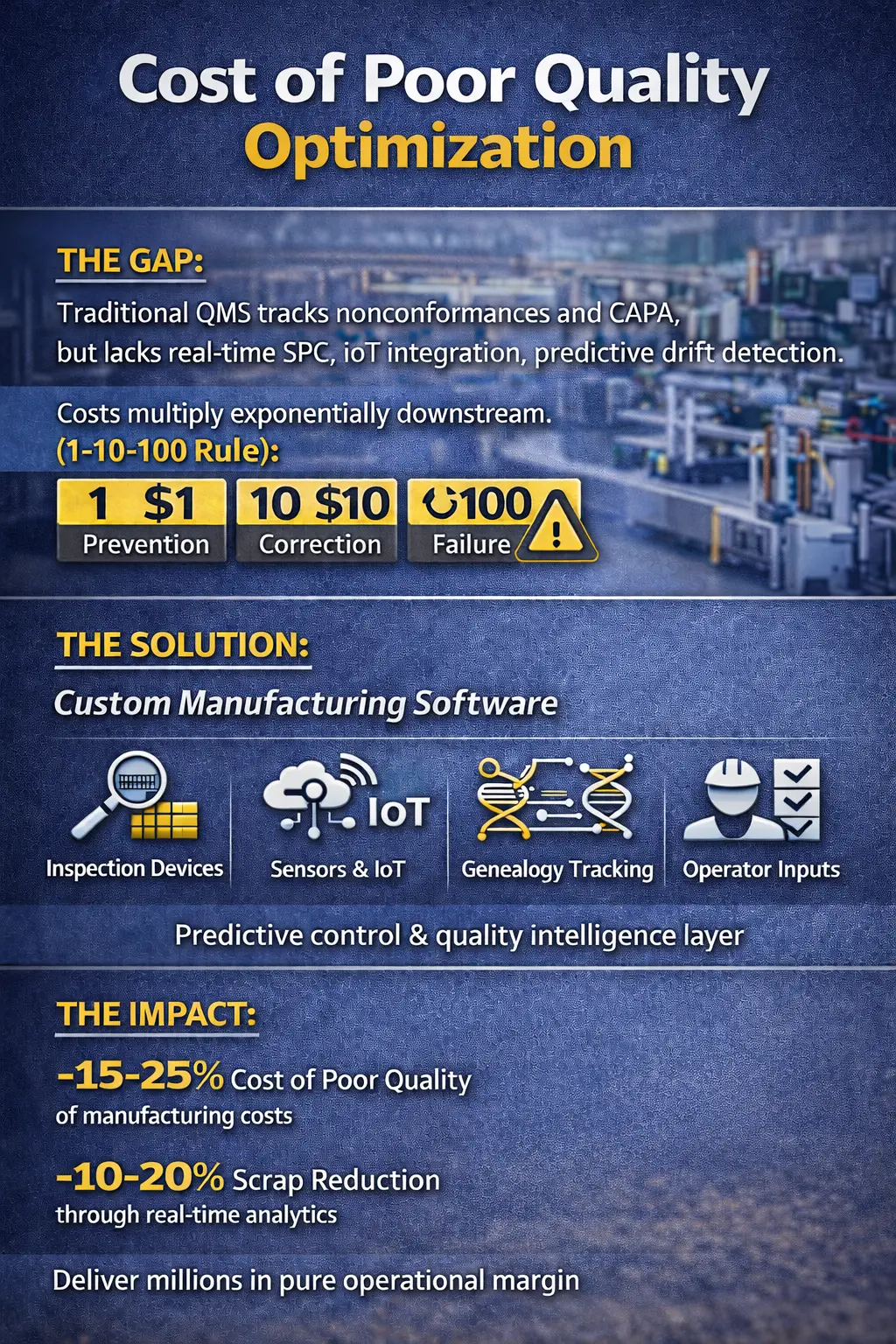
Traditional QMS platforms track non-conformances and CAPA , but they rarely enable intelligent manufacturing because they lack real time SPC, IoT integration, and predictive drift detection. As defects move downstream, costs multiply exponentially, consistent with the widely cited 1 10 100 rule.
Custom software for manufacturing as the solution:
A custom software solution closes this gap by building a quality intelligence layer on top of ERP and MES. These custom manufacturing software platforms integrate inspection devices, sensors, genealogy, and operator inputs to shift quality from reactive reporting to predictive control. Industry studies show COPQ typically represents 15 to 25 percent of manufacturing costs, and manufacturers using real- time analytics often achieve 10 to 20 percent scrap reduction, delivering direct margin expansion. This is a high ROI path to production scheduling optimization and broader operational performance, especially when paired with predictive maintenance manufacturing.
3. Inventory Accuracy and Working Capital Optimization
The Gap:
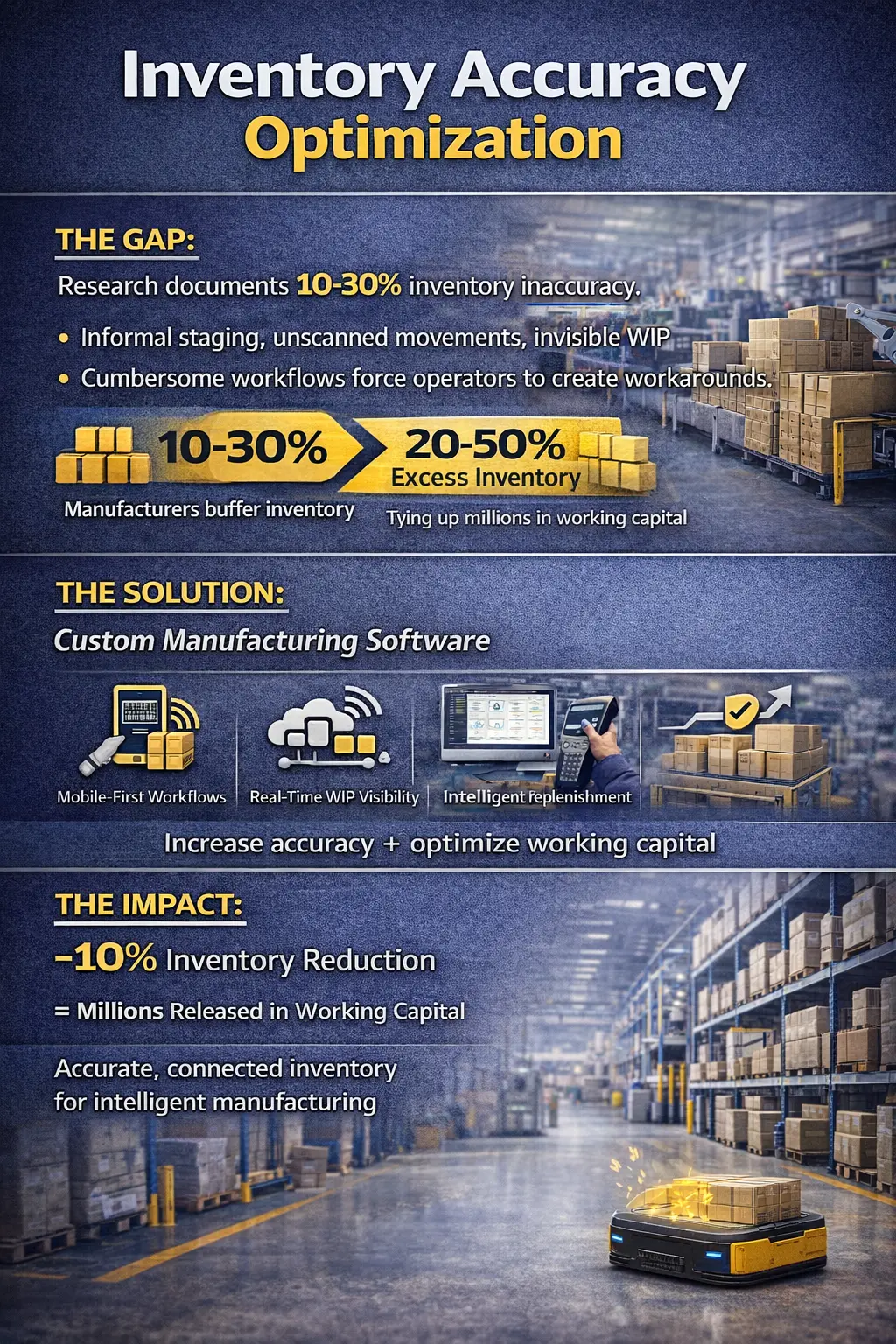
Research finds 10 to 30 percent inventory record inaccuracy in many operations, driven by informal staging, unscanned movements, and WIP that sits outside system visibility. When workflows are slow or cumbersome, operators create workarounds. The result is predictable: manufacturers carry 20 to 50 percent excess inventory as buffers, tying up working capital and masking root causes instead of fixing them. (Source)
Custom software for manufacturing as the solution:
The fix is operational, enabled by software. A targeted custom software solution builds an inventory intelligence layer on top of ERP and WMS through custom manufacturing software. Mobile first execution workflows, real time WIP visibility, and intelligent replenishment make accuracy easier than workarounds. Even a 10 percent inventory reduction can release millions in working capital while improving service levels, and it compounds when connected to intelligent manufacturing, production scheduling optimization, and predictive maintenance manufacturing.
4. Predictive Maintenance Manufacturing
The Gap:
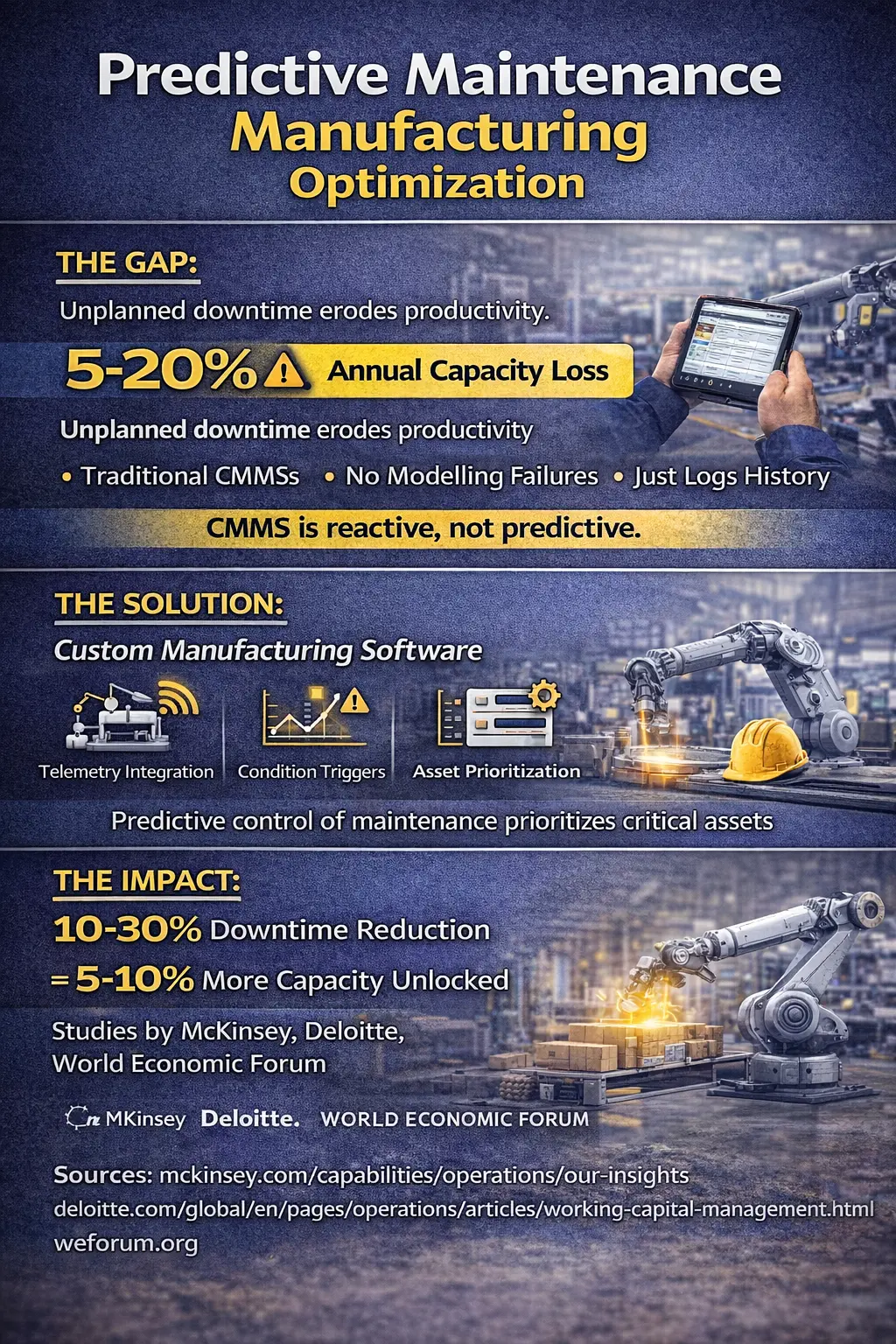
Unplanned downtime still consumes 5 to 20 percent of annual productive capacity, according to research from McKinsey and Deloitte. Traditional CMMS platforms are built for recordkeeping. They log work orders and history but lack real time sensor integration, condition based triggers, and failure modeling.
The result is reactive maintenance, not the predictive maintenance manufacturing required for true intelligent manufacturing.
Custom Manufacturing Software As a solution:
A targeted custom software solution shifts maintenance from reactive tracking to predictive control. Through custom manufacturing software, telemetry is integrated with production and operational data to detect early failure signals and prioritize critical assets.
Industry studies show 10 to 30 percent downtime reduction from predictive maintenance programs. Even a 5 to 10 percent improvement can unlock significant capacity without capital investment, directly increasing throughput and margin. (Source)
5. Traceability and Recall Containment
The Gap:
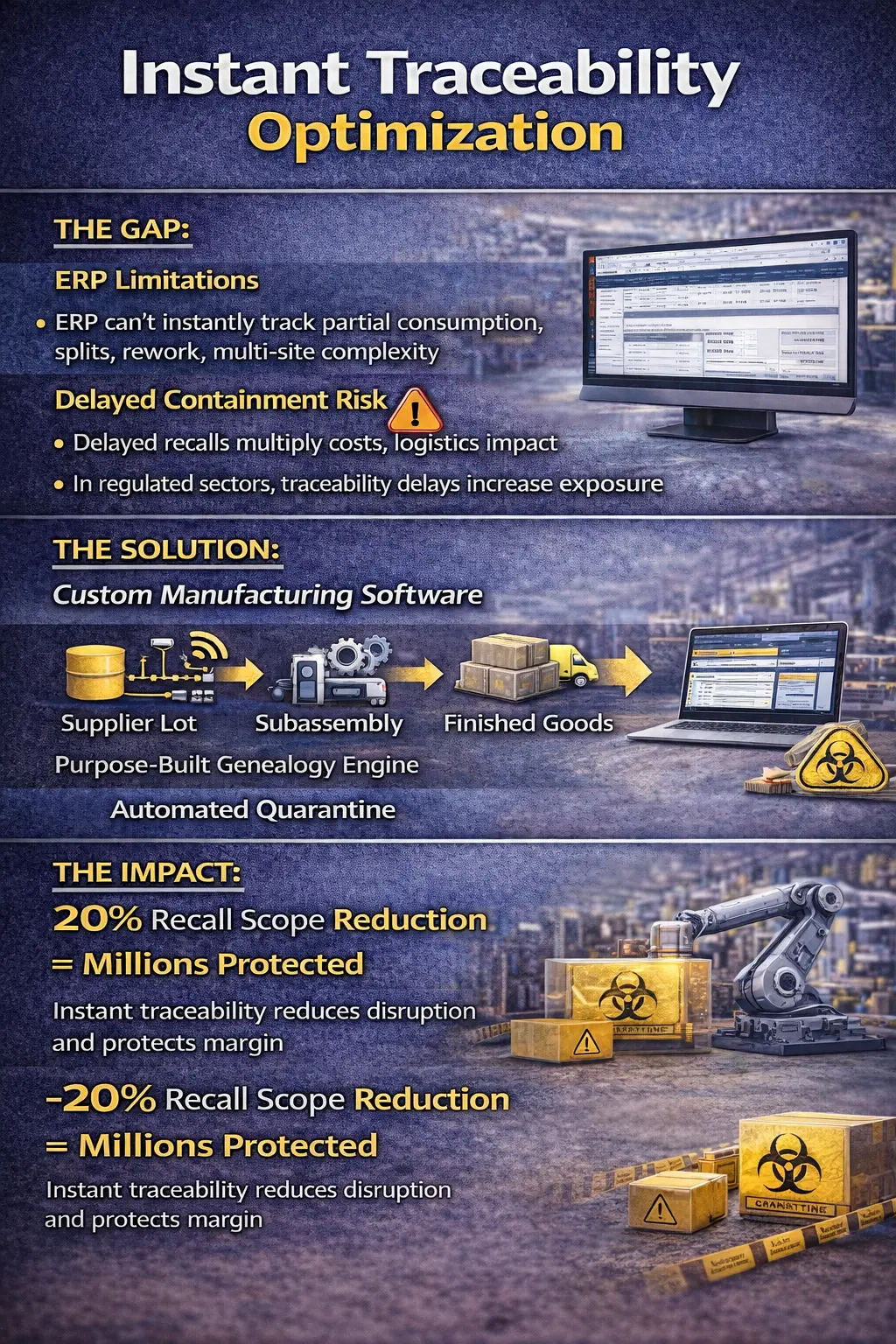
ERP can record batches, but it cannot build real time genealogy across partial consumption, lot splits, rework loops, and multi site production. In regulated industries, traceability speed determines exposure. Delayed containment expands recall scope and multiplies cost.
Custom Manufacturing Software As a solution:
Purpose built genealogy engines, delivered through custom manufacturing software, map supplier lot to finished goods to shipment in minutes and trigger automated quarantine. Studies and regulator guidance emphasize that faster containment reduces disruption and cost. Even a 20 percent recall scope reduction can protect millions, making instant traceability a core capability for intelligent manufacturing operations.
Most manufacturers don’t lose performance because they lack systems. They lose it because their systems weren’t built for their plant reality.
ERP and off-the-shelf tools are strong at standardization, compliance, and financial integration. But they struggle with day-to-day execution where value is created: sequencing, changeovers, quality response time, downtime prevention, and traceability.
That’s why leaders layer custom software solutions on top of ERP — to connect plan to execution and manage constraints in real time.
Custom manufacturing software is built around what actually drives results:
- Production scheduling optimization that uses your real constraints (changeovers, sequence rules, labor, materials)
- Intelligent manufacturing quality detection that identifies drift early and contains defects fast
- Inventory workflows that make accuracy automatic—not dependent on heroics
- Predictive maintenance manufacturing that prioritizes failures before they hit the constraint
- Traceability that narrows recall impact in minutes
When execution improves, the financial impact follows:
- +5% OEE (production scheduling optimization) → capacity gain without CapEx
- -2% scrap (intelligent manufacturing) → direct margin expansion
- -10% inventory (custom software solutions) → working capital release
- -10% downtime (predictive maintenance manufacturing) → throughput increase, no new assets
- -20% recall scope (custom manufacturing software) → major liability protection
This isn’t about replacing ERP. It’s about fixing what ERP doesn’t control: real-time plant execution.
If you answer “yes” to any of these, you have a strong business case for custom software solutions:
- Production Scheduling Optimization
Are schedules routinely overridden in spreadsheets or supervisor whiteboards? - Intelligent Manufacturing Quality
Do defects get detected hours or days after they’re created? - Inventory Accuracy
Do teams verify inventory manually because system counts aren’t trusted? - Predictive Maintenance Manufacturing
Do failures still surprise you—because you can’t reliably predict 48 hours ahead? - Traceability
Would a recall take hours to isolate affected lots, lines, and customers?
Where these gaps exist, custom manufacturing software is not an experiment—it’s a high-ROI control layer.
Your competitors aren’t just running the same ERP anymore. The leaders are building on top of it with custom software solutions that turn constraints into measurable advantage.
That performance gap isn’t your equipment. It isn’t your people. It’s the custom manufacturing software they built and you didn’t.
The question isn’t whether to invest. It’s whether you can afford not to, while intelligent manufacturing becomes the baseline.